Abu Dhabi · Global ambition
Capital forappliedintelligence.
AI-led ventures in health,
climate and financial infrastructure.

AI that earns its place
in industry.
Our conviction:
adoption creates value.
A model can improve overnight. A company’s advantage must survive the next model release.
Our investment thesis centres on technology embedded in essential workflows: the systems a hospital, enterprise, energy operator or financial institution depends on. We look for domain expertise, legitimate access to useful data and a product that customers have a reason to keep using.
AI is the core of our focus. Across health, climate and finance, we also study the scientific and infrastructure advances that make new applications possible.
How we assess an AI ventureBuyer & workflow.
Who uses the product, who controls the budget and what changes in their working day? We look for a recurring need and evidence that the existing alternative is inadequate.
Technical advantage.
Domain-specific evaluations, usable data rights, integration depth and product expertise. The edge should be explainable beyond access to a third-party model.
Repeatable economics.
Cost per completed task, including inference and human review. Deployment effort, customer retention and a credible path from the first implementation to the next.
Four investment themes.
AI at the core.
From enterprise software to life sciences,
we study the product, the buyer
and the path to adoption.
01AI & digital infrastructure
Software → physical systems
Enterprises with high-volume knowledge work; industrial and logistics operators with complex physical processes.
What we look forPerformance on the customer’s own tasks, a workable data model and lower cost per accepted outcome after human review.
Our AI investment lens- Enterprise agents
- Document processing, service operations and workflow automation with permissions, traceability and human oversight.
- AI infrastructure
- Data pipelines, evaluation, model monitoring and efficient inference; Arabic and English language applications.
- Physical AI
- Computer vision, robotics and predictive maintenance for factories, warehouses and other operational environments.
02Health & life sciences
Research → care delivery
Care providers, laboratories and research teams managing fragmented information, capacity constraints and complex decisions.
What we look forA clearly defined intended use, evidence appropriate to the product’s stage and a realistic clinical, regulatory and integration pathway.
The Smart Mirror collaboration- Digital health
- Connected care, remote monitoring and tools that reduce administrative work across the patient journey.
- MedTech
- Medical devices, diagnostic support and clinical workflow tools with a defined role for the practitioner.
- Life-science platforms
- Bioinformatics, discovery software, laboratory automation and enabling technologies for biotechnology.
03Climate & energy
Resources → productivity
Building owners, utilities and industrial operators balancing energy, water and material use with cost and operational reliability.
What we look forA measurable physical baseline, savings that hold under real operating conditions and adoption economics that include installation and maintenance.
How to structure a pilot- Energy systems
- Cooling and building optimisation, grid intelligence, storage management and industrial energy efficiency.
- Water & food systems
- Water monitoring and reuse, efficient production and technologies that reduce loss across food supply chains.
- Industrial decarbonisation
- Emissions measurement, process optimisation and circular materials with a verifiable resource or carbon benefit.
04FinTech & digital assets
Transactions → trust
Financial institutions and businesses moving money, reconciling transactions and managing risk across fragmented systems.
What we look forA specific customer use case, robust security and controls, and a clear understanding of the permissions required to operate.
Prepare a technology brief- Financial infrastructure
- Payments, reconciliation, treasury operations and software connecting financial institutions with business customers.
- Risk & compliance technology
- Fraud detection, identity verification and auditable workflows that help teams investigate and manage risk.
- Digital asset infrastructure
- Tokenisation systems, custody technology, wallet security and blockchain infrastructure built around business utility.
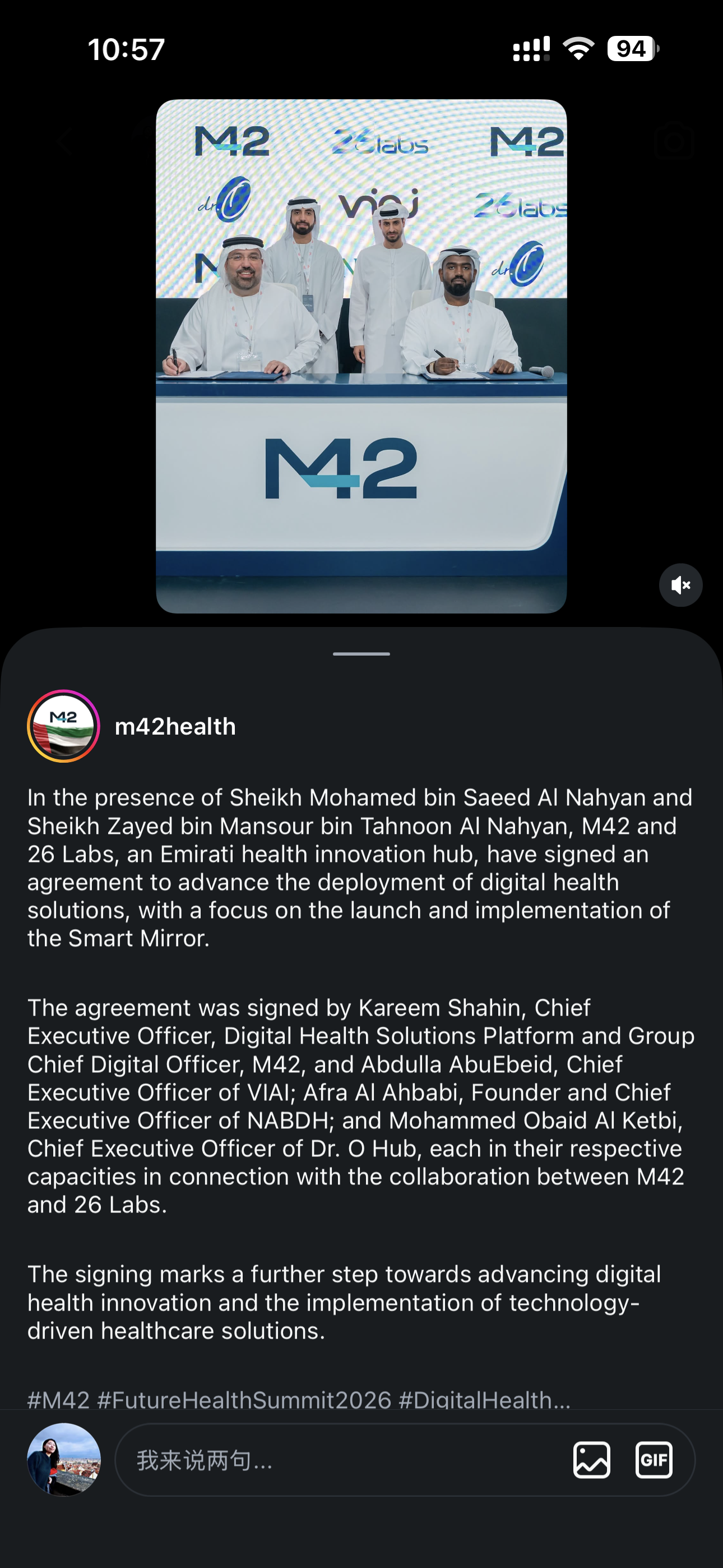
Digital health / Collaboration
Smart Mirror.
A path into care.
M42 and 26 Labs signed an agreement to advance digital health solutions, with a focus on the launch and implementation of the Smart Mirror.
Dr.O was represented at the signing by Mohammed Obaid Al Ketbi, alongside representatives of M42, VIAI and NABDH.
Inside the collaborationBuilt for the market.
Ready for the region.
Local adoption is a product question,
as much as a market opportunity.
Abu Dhabi’s technology priorities are reflected in Hub71’s specialist ecosystems for AI, life sciences, climate technology and digital assets. These fields inform our investment focus.
For a company entering the region, the practical questions start with the buyer: local workflows, Arabic and English usability where needed, data and hosting requirements, procurement and long-term support.
Our collaboration agenda brings the product team and the industry problem into the same brief: what to deploy, what it must prove and what a repeatable commercial model would require.
Build the collaboration briefThe questions
behind the conviction.
How we examine technology businesses
and the evidence needed to adopt them.


Bring the product.
Define the next milestone.
A focused first discussion starts
with the problem, the evidence
and the decision ahead.
01For AI founders
Show how your product changes a recurring customer task. Connect the technical advantage to current evidence and the milestone that new capital would enable.
Prepare for the first discussion
- A product demonstration, target buyer and existing alternative
- Team expertise, technology ownership and data rights
- Evaluation results; usage, retention and revenue where available
- Deployment costs, next milestone and proposed use of capital
02For technology companies
Define the application you want to build in the region. Explain what is already proven, what needs adaptation and who would operate and support it.
Prepare a deployment brief
- Demonstrated use cases and reproducible performance evidence
- APIs, integration effort, data handling and hosting requirements
- Language support, product ownership and commercial rights
- Implementation responsibilities and ongoing service model
03For industry partners
Start with a process you own and a result you need to improve. A useful challenge brief lets a technology team understand the operating conditions before proposing a solution.
Prepare an industry challenge
- One workflow, its volume, current cost and operational owner
- Available data, systems and security requirements
- Success measures, acceptable error and the role of human review
- The budget owner and conditions for moving beyond a pilot
One workflow. An agreed baseline. A decision on what happens next.
Read the pilot frameworkA closer look
Before we begin.
Which sectors are in focus?
Our four investment themes are AI and digital infrastructure; health and life sciences; climate and energy; and FinTech and digital assets. AI is a cross-sector priority, from enterprise software and robotics to clinical workflows, energy optimisation and financial operations.
Does every company need to build its own AI model?
No. We look at where the defensible advantage sits: proprietary technology, domain knowledge, legitimate access to data, workflow integration or a combination of these. Life-science and climate opportunities can also centre on scientific or engineering advances rather than AI alone.
What makes an opportunity relevant to Abu Dhabi?
A clearly identified customer need in the region and a credible delivery plan. We consider product localisation, data and operating requirements, the purchasing process and support after deployment, alongside the potential to serve other markets.
What evidence matters at an early stage?
Evidence should match the stage. A research-led team may bring validation results, intellectual property and a development plan. A working product should show task-level performance and user feedback. A commercial business should also explain retention, revenue quality and delivery economics.
Can established technology companies and industry partners participate?
Yes. Our collaboration focus includes companies adapting proven technology for regional use, and industry teams with a defined operational challenge. The starting point is a deployment or challenge brief: the use case, responsible team, operating constraints and evidence needed for the next decision.